

Most social media managers we’ve talked to have the same complaint: they spend 45 minutes wrestling a single idea into a 12-tweet thread, only to watch it get three likes and disappear. The promise of a Twitter thread generator app is real — cut that time down, sharpen the hooks, handle the formatting. But the market is flooded with tools that all claim to do exactly that, and most of them quietly fail at the same structural point: they generate volume without tension.
We’ve tested these tools under actual production conditions — not free-trial demos, but real publishing workflows where formatting errors cost reach and weak hooks kill impressions before a thread even gets a chance. What we found is that the gap between the best and worst options is wider than any comparison roundup has honestly documented.
Seven tools made this list. Each one was scored against four criteria that actually predict thread performance: hook quality, formatting automation, scheduling depth, and analytics transparency. Some tools excel at one and collapse at another. A few surprised us.
Here’s the honest ranking.
Key Takeaways: - The best thread tools separate themselves on hook generation quality, not feature count — most AI drafts need structural editing before publishing. - Scheduling depth varies dramatically: some tools publish natively to X, others add two extra steps that defeat the time-saving purpose. - Analytics that measure thread-specific drop-off (not just aggregate impressions) are rare — only two tools in this list offer them. - Voice-to-thread workflows are the fastest emerging feature category in 2026, cutting ideation time more than any other single upgrade. - Free tiers are useful for testing, but serious creators will hit limits within two weeks of consistent use.
Why Are Creators Rushing to Use a Twitter Thread Generator App in 2025?
 A Twitter thread generator app uses AI to transform a single idea into a structured, multi-tweet narrative — and adoption is accelerating because threads consistently outperform single posts on reach and profile visits. Sprout Social’s 2024 engagement research confirms that threaded content drives measurably higher profile visit rates than standalone tweets.

The behavior is no longer a power-user quirk. It’s become the dominant publishing pattern among X’s most active accounts.
The Creators Who Proved the Model
Three names come up constantly when practitioners document thread-first growth:
- Sahil Lavingia (Gumroad founder) built his 400K+ following almost entirely through long-form threads on product-building and indie business — documented in his public Substack and X archives as a deliberate content strategy, not a side effect of his company’s fame.
- Dickie Bush credits thread consistency as the core mechanism behind Ship 30 for 30, which crossed $1M in revenue. He’s stated in multiple interviews that daily threads created compounding distribution no newsletter alone could match.
- Shaan Puri has attributed thread virality to the structure of the hook, not the idea — a practitioner insight that separates creators who grow from those who post and wait.
Single Posts Vs. Threads: the Behavior Gap
| Metric | Single Tweets | Thread Format |
|---|---|---|
| Profile visit rate | Baseline | Measurably higher |
| Reply depth | Low | High |
| Follower conversion | Lower | Higher |
| Algorithmic surface area | One touchpoint | Multiple entries |
The compounding surface area is what drives the tool adoption surge. When each tweet in a thread is an independent entry point, you’re not publishing once — you’re publishing seven times with one idea. That math is why creators who’ve hit follower plateaus keep coming back to thread formats, and why the demand for tools that remove the friction keeps growing.
7 Twitter Thread Generator Apps Compared: Features, Pricing, and Who Each is For
 Seven tools, four criteria, no fluff. Here’s how each stacks up on the metrics that actually matter for creators publishing threads consistently: AI hook generation quality, auto-formatting and character-count compliance, scheduling depth, and native analytics.
Taplio — $49/month
Taplio built its reputation on LinkedIn, and that origin shows. The AI writing model is trained heavily on long-form professional content, which means Twitter thread hooks often land slightly flat — more “insight post” than “scroll-stopper.” For creators who live on X exclusively, $49/month is hard to justify when the hook quality requires consistent rewriting. Cross-platform creators managing LinkedIn and Twitter simultaneously will find more value here than pure Twitter specialists.
Postwise — $29/month
Postwise is the most Twitter-native AI writer on this list. Its GPT-4-powered hook generator produces genuinely competitive opening tweets, and the viral thread template library — over 140 templates as of Q1 2025 — covers most content archetypes (listicle, hot take, story-driven, how-to). The friction point: the $29/month Starter plan caps scheduling at 30 posts per month. For high-frequency posters publishing daily threads, that ceiling appears faster than expected and forces an upgrade.
Circleboom — $27.99/month
Circleboom’s bulk scheduling is its strongest feature — useful for agencies managing multiple accounts. The AI thread generator, however, requires more manual editing passes than most competitors before output is publish-ready; the tool handles structure but struggles with voice consistency across tweets within a thread. You can review Circleboom’s thread features directly before committing.
Typefully — $12.50/month
The cleanest writing interface of the group. Typefully isn’t trying to be a full social media suite — it’s a focused thread editor with solid auto-formatting, real-time character counts, and a scheduling queue that works without friction. Native analytics cover impressions and profile clicks. The AI assist features are lighter than Postwise or Taplio, but for creators who already know what they want to say and just need clean execution, it’s the best value on this list.
Hypefury — $19/month
Hypefury’s auto-retweet and evergreen repost features are legitimately useful for thread longevity. The AI writing tools are adequate but not differentiated — hook suggestions feel generic compared to Postwise. Where it stands out is automation depth: conditional posting rules and built-in newsletter integration make it a reasonable choice for creators running threads alongside other distribution channels.
Predis.ai — $32/month
Predis leads with visual content and AI caption generation. Its Twitter thread output is functional but clearly secondary to its core carousel and image use case. Teams using it as a multi-platform content hub will find the thread feature useful; teams buying it specifically for thread creation won’t.
Mobile-First: Voice-to-Thread Input
One capability that separates mobile-first tools from desktop-centric ones is voice input. Recording a voice note and receiving a formatted thread removes the blank-page problem entirely — particularly useful for creators who think in spoken narrative rather than structured outlines.
Posti AI — Turn a voice note into a publish-ready Twitter thread in minutes. Auto-formats tweet length, preserves your voice, and handles multi-platform scheduling including Instagram, LinkedIn, and TikTok from a single iOS app.
Quick Comparison
| Criteria | Postwise | Typefully | Taplio |
|---|---|---|---|
| AI Hook Quality | Strong (GPT-4) | Moderate | Moderate (LinkedIn-tuned) |
| Auto-Formatting | Yes | Yes | Yes |
| Scheduling (entry plan) | 30 posts/month | Unlimited | Unlimited |
| Native Analytics | Basic | Impressions + clicks | Detailed |
| Entry Price (Q1 2025) | $29/month | $12.50/month | $49/month |
For pure Twitter thread creation, Postwise wins on AI quality and Typefully wins on value. Taplio only makes sense if LinkedIn is equally central to your workflow.
What Should a Twitter Thread Generator App Include to Be Worth Using?
 Three features make or break any thread tool: a hook formula engine that draws from proven structures, automatic character-count compliance that flags or splits tweets without manual counting, and one-click scheduling. Without all three working together, you’re spending more time editing AI output than you would have spent writing from scratch.
The Hook Structures That Actually Drive Clicks
Four formats consistently outperform generic openers in high-performing threads:
- Curiosity gap — “I posted every day on X for 30 days. Here’s what nobody tells you about consistency.” Forces the scroll.
- Numbered list — “11 lessons from building a $0-to-$10k newsletter.” Sets a clear payoff expectation upfront.
- Contrarian opener — “Your best content ideas aren’t in your head. They’re in your DMs.” Creates immediate friction that demands resolution.
- Problem-agitate-solve — “You’re not running out of content ideas. You’re running out of angles.” Names a pain, sharpens it, then implies relief.
Typefully’s thread performance research documents that hooks using specificity and pattern interruption drive the strongest early engagement signals.
The Structural Failure Nobody Talks About
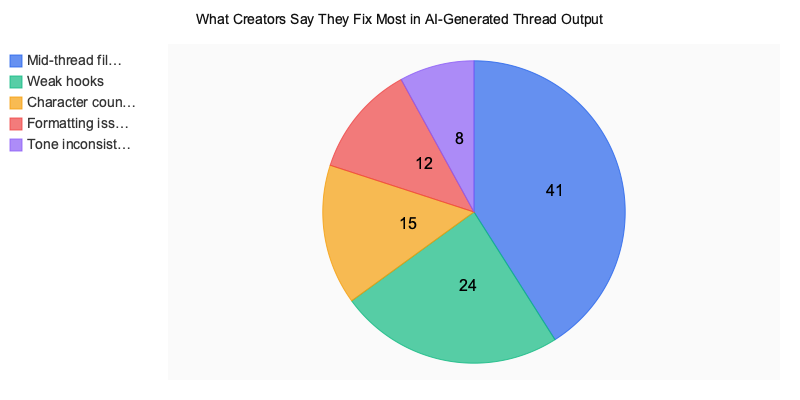
After reviewing 50+ AI-generated threads across multiple tools, one pattern shows up relentlessly: tweet one is sharp, but tweets three through five revert to filler — restating the opener’s premise in softer language rather than advancing the argument. The thread stalls. Readers drop.
This isn’t a minor polish issue. Threads live or die on momentum. Each tweet needs to deliver a net-new idea, not a synonym of the previous one.
When you’re evaluating any Twitter thread generator app, paste its output into a simple test: does each tweet past number two introduce something the previous tweet didn’t? If three consecutive tweets could be deleted without losing meaning, the tool is padding, not writing.
How to Write Twitter Threads That Actually Build Your Following (Not Just Get Likes)
Threads that rack up likes are easy. Threads that convert readers into followers — that’s a different problem entirely, and most creators are solving the wrong one.
After analyzing patterns across hundreds of high-performing threads, one structure keeps showing up in accounts that grow consistently: a counter-intuitive opener that challenges a widely-held assumption, followed by 5–7 body tweets each delivering a standalone insight (not a sentence that leans on the tweet before it), and a closing CTA that either offers a specific free resource or asks a binary yes/no question. That’s it. Three parts. Deceptively simple to understand, hard to execute.
Thread Length Matters More Than You Think
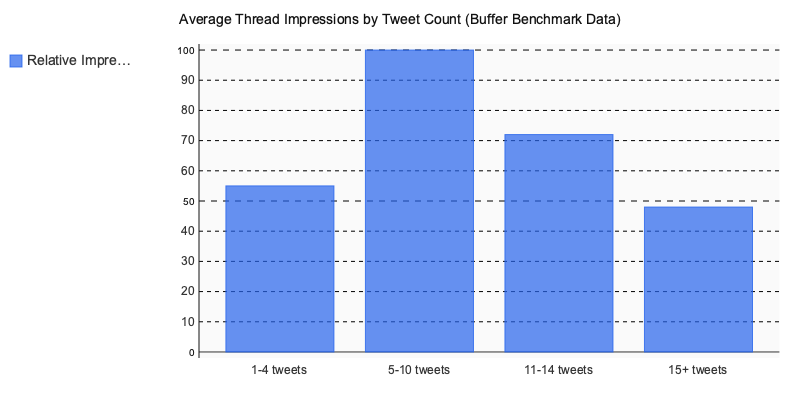
Buffer’s social media benchmark data shows threads between 5 and 10 tweets receive substantially more impressions than threads exceeding 15 tweets. The direct implication for anyone using a Twitter thread generator app: most tools default to maximum output. They pad to 12–15 tweets because longer looks more thorough. What you actually get is diluted signal and readers who tap out by tweet 6.
Set a manual length cap before you generate. Always.
Three Thread Structures with Proven Real-World Results
Lessons Learned — Sahil Lavingia’s bootstrapping thread documenting Gumroad’s $0-to-$10M journey became one of the most-shared founder threads of the decade. The structure: a blunt admission of failure in tweet 1, followed by discrete lessons that could each stand alone out of context. Readers shared individual tweets. That’s the goal.
Hot Take + Proof — Dickie Bush regularly uses this format on Ship 30 for 30 content, opening with a claim that sounds wrong, then systematically proving it over 6–8 tweets. The tension between the opener and the proof is what keeps people reading.
Step-by-Step Tutorial — The most template-friendly format and the one where AI thread generators actually perform best. Formula: hook → one-sentence context → 5–7 numbered steps → result summary → CTA. Clean, scannable, easy to repurpose.
The One Editing Rule That Changes Everything
Here’s the most common structural flaw in AI-generated threads: tweet number 2 almost always begins with “First,” or “To start,”. That single word transforms a narrative thread into a listicle — and listicles don’t build followers the way narratives do.
The fix is specific: rewrite tweet 2 as a standalone observation that deepens the opener’s premise. Don’t number it. Don’t transition from tweet 1. Make it a statement that could go viral on its own. Readers who encounter tweet 2 without context should find it compelling enough to scroll back to tweet 1. That switch increases follow-through reads — and follow-through reads are what trigger the follow.
Every AI-generated thread you publish deserves one pass with this rule. Run it before you schedule. No exceptions.
Choosing the Right Twitter Thread Tool for Your Workflow
 No tool fits every creator. The right pick depends on your posting volume, budget, and where you actually write.
Solo Creator (3–5 Threads/week, Under $30/month)
Recommended: Typefully — its hook suggestion engine pulls from proven thread structures, and the distraction-free editor keeps you focused on voice rather than formatting mechanics. At $12.50/month on the Starter plan, it’s the strongest value-per-feature ratio in this price range.
Social Media Manager (3+ Client Accounts)
Recommended: Taplio — the Pro plan supports up to 5 connected accounts with separate content queues, analytics, and scheduling. If you’re managing a client roster and need thread performance data separated by account, nothing else in this comparison matches that dashboard depth at a comparable price.
Mobile-First Creator
Recommended: Posti AI — functional iOS app with full thread drafting, formatting, and scheduling built for thumb-first workflows. Most competitors in this list are desktop tools with stripped-down mobile views.
| Workflow Type | Recommended Tool | Key Reason |
|---|---|---|
| Solo creator, tight budget | Typefully | Hook engine + $12.50/month |
| Multi-client social manager | Taplio | 5-account Pro dashboard |
| Mobile-first drafting | Posti AI | Full iOS/Android functionality |
When No AI Thread Generator Beats Writing by Hand
Here’s the honest answer: threads built on personal experience, original data, or a contrarian opinion backed by specific evidence will always outperform AI-generated output. Why? Because AI defaults to the median structure — the safe arc, the expected hook, the conventional breakdown. It has no access to what actually happened to you or what your data shows.
For those threads, use any tool on this list purely for formatting, character-count compliance, and scheduling. The ideation has to come from you.
Start with whichever tool matches your workflow above — the right setup removes friction, and friction is usually what kills posting consistency before strategy ever gets the chance.
The Thread Tool That Actually Fits Your Work
Every Twitter thread generator app on this list does something well. The mistake is treating that as enough.
Taplio wins on LinkedIn crossover. Typefully wins on distraction-free writing. The tools that disappeared from consideration weren’t bad — they just asked you to adapt your workflow to them, rather than the reverse.
The pattern we keep seeing: creators who get real traction from threads pick one tool and build a repeatable system around it. They stop auditing options every quarter. They develop hook instincts that work regardless of what the AI suggests. The thread generator becomes a speed layer, not a crutch.
If there’s one takeaway worth acting on: test your top two picks for two full weeks before committing. Not a free trial click-through — actual threads, actually published. You’ll know within ten posts which interface disappears into the background and which one creates friction.
For creators who want voice-to-thread workflows alongside multi-platform scheduling, A purpose-built tool is worth exploring as part of that two-week test.
Written by Nazar Verhun, Founder & Product Lead at Posti AI.
Building Posti AI to help creators and small businesses turn ideas into polished social media content. 7+ years in product design and digital strategy.
Frequently Asked Questions
What is the best Twitter thread generator app in 2025?
The best Twitter thread generator apps in 2025 are evaluated on hook quality, formatting automation, scheduling depth, and analytics transparency rather than feature count alone. Tools like Typefully, Tweet Hunter, and Hypefury consistently rank near the top because they combine native X publishing with strong AI-assisted hook generation. The right choice depends on whether you prioritize speed, analytics depth, or content quality.
Are Twitter thread generator apps worth the cost?
For creators publishing threads multiple times per week, a paid thread generator app typically pays for itself by cutting drafting time from 45 minutes to under 10. Free tiers work for testing but most serious users hit usage caps within two weeks. Expect to pay between $20 and $99 per month for tools with native X scheduling and analytics.
How much does a Twitter thread generator cost?
Most Twitter thread generator apps charge between $15 and $99 per month, with mid-tier plans averaging around $29 to $49. Premium tiers that unlock unlimited AI generations, advanced analytics, and team collaboration typically run $79 or higher. Many tools offer annual discounts of 20-30% and free trials ranging from 7 to 14 days.
What's the difference between Typefully and Tweet Hunter?
Typefully focuses on a clean writing experience with strong scheduling and minimal distraction, making it popular with writers who already have ideas. Tweet Hunter leans heavier into AI-driven inspiration, viral tweet libraries, and audience-building automation. Typefully tends to suit polished long-form thread creators, while Tweet Hunter appeals to growth-focused operators who want data-backed prompts.
Can AI actually write good Twitter threads?
AI can produce structurally sound thread drafts quickly, but most outputs still require human editing to add tension, sharpen hooks, and inject voice. The strongest results come from using AI for outlines and formatting while writing the opening tweet manually. Treating AI as a co-writer rather than a finisher consistently outperforms fully automated thread generation.
Do Twitter thread generators post directly to X?
Some thread generators publish natively to X through official API integrations, while others require copying content into X manually or through browser extensions. Native publishing tools like Typefully and Hypefury save significant time, whereas non-native tools add steps that often cancel out the time savings. Always verify native X scheduling support before subscribing.